
Kangan Upadhye.


Legal Think Tank
While consulting at Daksh, I designed and operationalised a bespoke Judicial Policy Evaluation Framework—an approach that applies complexity theory to the real-world challenges of the Indian judiciary.
This flexible framework enables decision-makers to conduct comparative, ex-ante assessments of judicial policies before implementation, accounting for interdependencies, systemic feedback loops, and cascading impacts. It helps the judiciary anticipate how reforms might play out within a complex institutional ecosystem, rather than relying solely on linear projections.
• Scalable Toolkit: Delivered a practical evaluation model for ongoing judicial innovation and reform—now extendable to other sectors and policy domains.
This engagement set a new benchmark for rigorous, systems-focused reform in India’s democratic legal sector. The complexity-based approach highlighted not only what to change, but how best to orchestrate transformation in a context where direct cause and effect are often elusive.

Methodology
Literature Review & Case Studies: The framework design commenced with an extensive review of judicial reform literature, evaluation frameworks from other complex systems, and relevant case studies. This provided theoretical and empirical grounding for the framework tailored to Indian judiciary’s complexity.
Problem Analysis & Policy Formulation: The issues in the Indian judiciary were analysed to define core reform objectives—efficiency, access, quality, transparency, and justice network effectiveness. A scenario analysis workshop with the DAKSH team was conducted to generate a broad list of 34 policy interventions aligned with these objectives.
Two-Step Evaluation Framework
• Screening Stage: Policy options were initially screened using three criteria—feasibility, desirability, and importance—to narrow down interventions from 34 to 17. This involved structured deliberations and ranking by the evaluation team to identify options with real potential and manageable implementation constraints.
• Assessment Stage: The shortlisted policies were then evaluated in depth across five dimensions—direct effects, indirect effects, cost-benefit impact, stakeholder influence, and local context dependencies—using qualitative inputs and a regression-based model to simulate policy impacts as part of a complex system.
• Data & Tools: Evaluation inputs combined qualitative expert assessments, stakeholder consultations, and existing judicial data where available. A customised evaluation toolkit was designed to convert qualitative scores into quantitative ratings to guide policy ranking.
• Design Principles: The framework’s core principles were derived from complexity theory, addressing system-wide interactions and cascading effects of policies, limiting policy overload, factoring local context variations, and explicitly considering stakeholder power and influence in reform adoption.
• Outputs: The framework produces a ranked set of policy recommendations with component-wise impact scores to allow decision makers to prioritise reforms effectively considering system intricacies and real-world constraints.
This robust evaluation methodology bridges theory and practice, enabling evidence-informed judicial reform in a multifaceted and dynamic institutional environment.
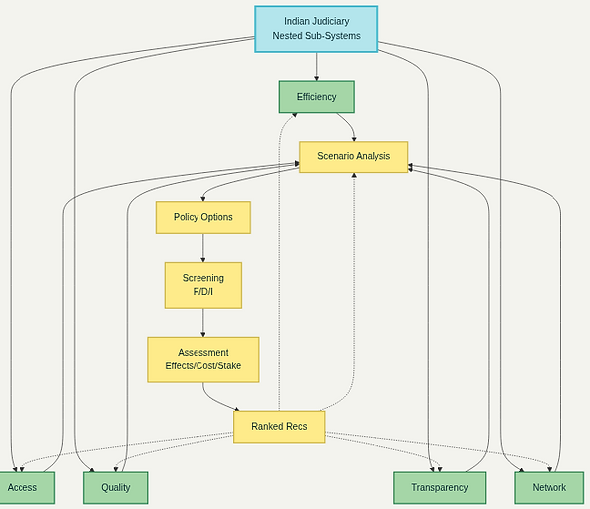
Judicial System Map
The map captures at a high level:
• The Indian judiciary as nested sub-systems and interacting stakeholders
• Core reform objectives (efficiency, access, quality, transparency, network)
• Flow from scenario analysis to policy selection, screening, and rigorous assessment
• Feedback loops and ripple effects between interventions and system objectives
• Interdependencies and portfolio-based decision-making
Additional Projects
The project outlined above led to further opportunities to apply systems thinking across other initiatives at Daksh
I contributed to a white paper outlining the blueprint for a next-generation judicial platform and co-authored a data-driven evaluation of legislative changes to India’s tax regime. These projects provided opportunities to translate systems thinking into actionable policy recommendations, advancing institutional reform through evidence and strategic insight.